Posts

Showing posts from 2024

What was Anandpur Sahib Resolution?

Image
  What was Anandpur Sahib Resolution? The Anandpur Sahib Resolution was  a statement with a list of demands made by the Punjabi Sikh political party, the Shiromani Akali Dal, in 1973 . The demands or the proposal drafted at Anandpur Sahib included following demands : Resolution No. 1-  Moved by Sardar Gurcharan Singh Tohra, president, Shiromani Gurdwara Parbandhak Committee. The Shiromani Akali Dal realizes that India is a union and republican geographical entity of different languages, religions and cultures. To safeguard the fundamental rights of the religious and linguistic minorities, to fulfill the demands of the democratic traditions and to pave the way for economic progress, it has become imperative that the Indian constitutional infrastructure should be given a real federal shape by redefining the Central and State relation and rights on the lines of the aforesaid principles and objectives. The concept of total revolution given by Lok Naik Jaya Parkash Narain is a...

The Tulsa Race Massacre of African Americans

Image
  The Tulsa Race Massacre of African Americans During World War I, the influence of Black Americans was rising, particularly in areas like Wall Street. Black neighborhoods, such as the well-known Black Wall Street in Greenwood, were prospering financially. White Americans largely tolerated this at the time, as Black Americans were needed to serve as soldiers in the war. On November 11, 1918, World War I officially ended. With the war over, the need that had driven this temporary tolerance also came to an end. Tensions escalated soon after. On May 30, 1921, Dick Rowland, a young African American shoe shiner, was falsely accused of assaulting a white elevator operator named Sarah Page in a building in downtown Tulsa. The next day, the Tulsa Tribune published a story claiming that Rowland had attempted to rape Page, along with an editorial suggesting that a lynching might take place that night. That evening, both Black and white crowds gathered outside the courthouse where Rowland was...

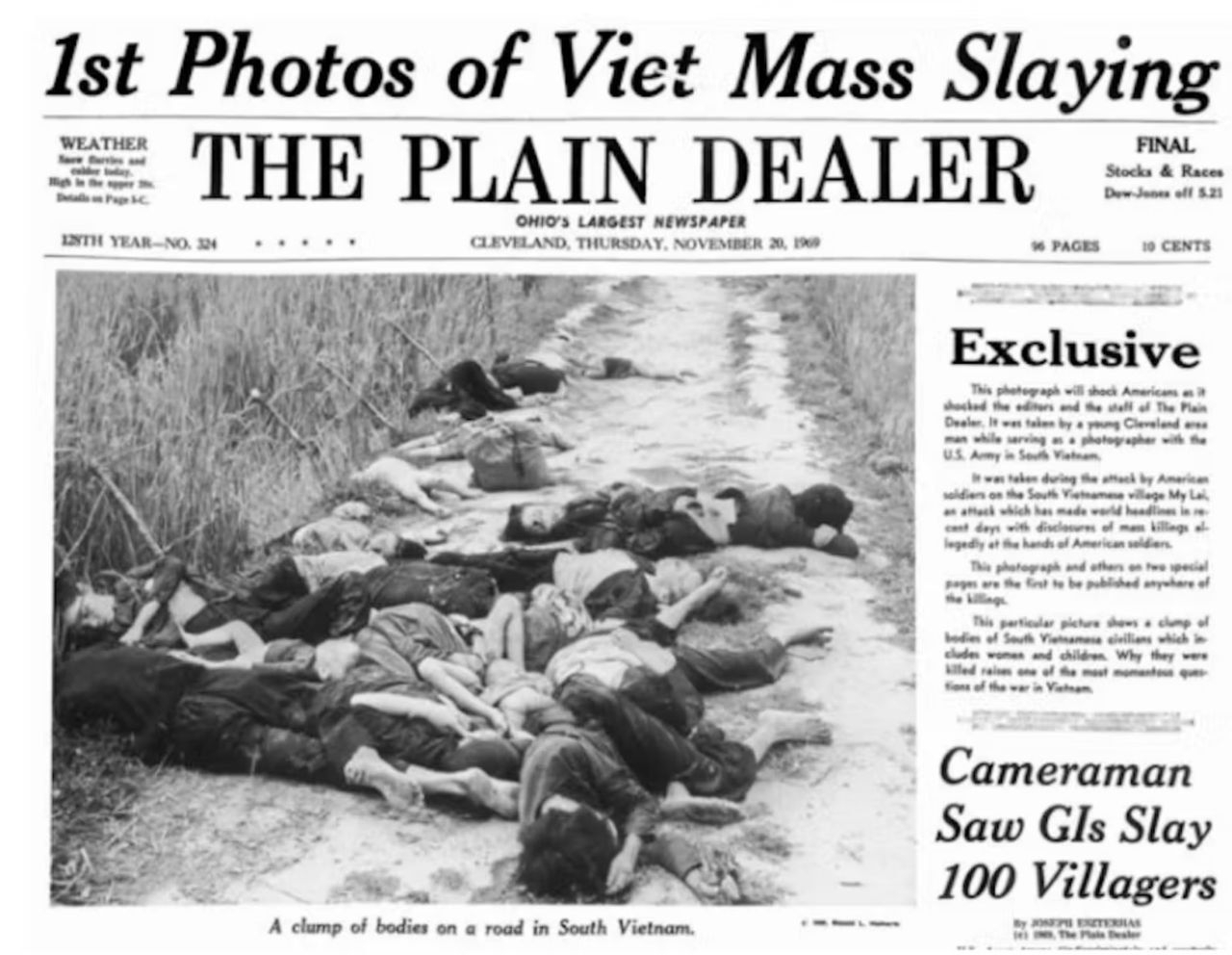
My Lai Massacre : A tale of rapes and cold blooded killings by US Army

Image
  My Lai Massacre : A tale of rapes and cold blooded killings by US Army. My Lai is a small village in Quang Nai Vietnam. US soldiers used to address this region as "Pinkville"  because of the reddish colour(meaning pro communist region) used to indicate the densely populated My Lai area on military maps.  By the time Charlie Company of the 1st Battalion, 20th Infantry Regiment, 11th Infantry Brigade, arrived in Vietnam in December 1967. “Pinkville” had earned a reputation as a heavily mined hotbed of Viet Cong activity. In January 1968 Charlie was one of three companies tasked with the destruction of the 48th Battalion, an especially effective Viet Cong unit operating in Quang Ngai province. Throughout February and early March, Charlie Company suffered dozens of casualties due to mines and booby traps, but it failed to engage the 48th Batallion. After the debacle of the broad Tet offensive, the...

Right to Recall Done Right: Why Most Existing Versions Fail — and How a Positive, Appearance-Based System Can Deliver Real Accountability

Image
Representative democracy asks voters to make one enormous judgment every five years, and then to live with the consequences of that judgment regardless of what the winner does afterward. If a legislator turns out to be corrupt, negligent, or simply absent, the constitutional remedy is patience — wait for the next election and hope memory holds. Recall mechanisms exist to shorten that feedback loop, and where they have been carefully designed — as more than a century of American, British, Swiss, and German experience shows — they have done exactly that, without the chaos critics predict. But shortening the feedback loop is not, by itself, a design. The record from India's own panchayats and from South America's most recall-heavy democracies shows that a badly built recall tool can produce something worse than the problem it was meant to fix: chronic instability, elite capture, or simple irrelevance. The question worth asking, then, is not whether citizens deserve a shorter leash...

When Stalin Invited Bhagat Singh: The Revolutionary Journey That Never Happened

Image
1. Introduction: The Invitation That History Never Saw In the summer of 1928, a Comintern delegate from the United Provinces boarded a long overland route toward Moscow, traveling through Iran to reach the Sixth Congress of the Communist International. His name was Shaukat Usmani, and before he left India, he did something that later accounts describe as an offer with genuinely world-historical stakes: he asked a twenty-year-old revolutionary from Punjab, already notorious to the colonial police but not yet the martyr the world would come to know, to come with him. That young man was Bhagat Singh. And according to accounts left by Usmani himself and corroborated by his close comrade Bejoy Kumar Sinha, the invitation did not stop at Usmani's own initiative — it reportedly carried the imprimatur of the Soviet Union's most powerful man. "Ask Bhagat Singh to come to Moscow," Usmani later recalled being told before his return to India in December 1928 (NewsClick, "Whe...

Rooftop Koreans: An example advocating for the importance of citizen ownership of firearms

Image
Rooftop Koreans: An example advocating for the importance of citizen ownership of firearms   Rooftop Koreans or Roof Koreans refer to the Korean American business owners and residents  who armed themselves and took to the rooftops of local businesses to defend themselves  during the 1992 Los Angeles riots .  The unrest in urban areas was sparked by the acquittal of four Los Angeles Police Department officers in the beating of Rodney King and resulted in rioting, and looting, along with widespread violence and arson throughout the city. For years, there had been tensions between the Los Angeles Korean community and the African American communities, including the killing of Latasha Harlins, an African-American teenager who was controversially fatally shot by a Korean-American convenience store owner who received no jail time. Following the Rodney King verdict, Los Angeles police were unable to provide protection to many affected areas due to the overwhelming scale of t...

From Matsya-Nyaya to True Justice: Why India Needs a Citizen Jury System — Lessons from Ancient Greece, Magna Carta, the United States, and Beyond

Image
A society progresses when it reliably rewards the good and restrains the bad. Indian political thought has a precise name for what happens when it fails to do either: Matsya-Nyaya, the law of the fish, where the strong devour the weak in the absence of any restraining order. Kautilya's Arthashastra treats Dand-Niti — the disciplined, impartial exercise of state power to punish wrongdoing — as the mechanism that keeps a society from sliding into exactly that condition. The question worth asking about India today isn't whether this principle is sound. It's whether the specific institution currently tasked with delivering it — a justice system built almost entirely around the judgment of a single, powerful individual — is actually built to succeed at the job. The Structural Problem With a Single Judge India's courts, from magistrate to High Court, generally concentrate final factual and legal judgment in one person, or a very small bench. This isn't merely a procedu...