Posts

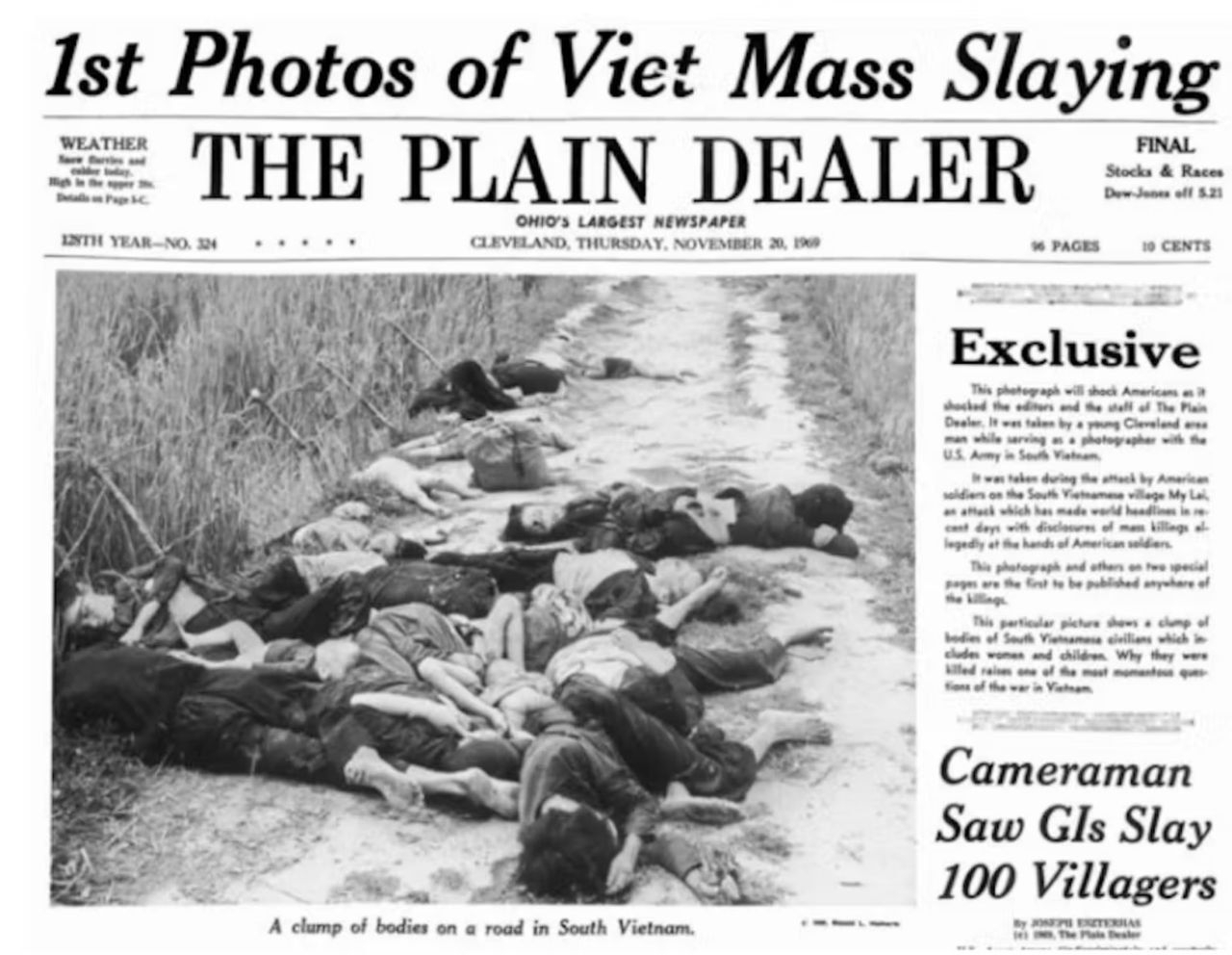
My Lai Massacre : A tale of rapes and cold blooded killings by US Army
Image
  My Lai Massacre : A tale of rapes and cold blooded killings by US Army. My Lai is a small village in Quang Nai Vietnam. US soldiers used to address this region as "Pinkville"  because of the reddish colour(meaning pro communist region) used to indicate the densely populated My Lai area on military maps.  By the time Charlie Company of the 1st Battalion, 20th Infantry Regiment, 11th Infantry Brigade, arrived in Vietnam in December 1967. “Pinkville” had earned a reputation as a heavily mined hotbed of Viet Cong activity. In January 1968 Charlie was one of three companies tasked with the destruction of the 48th Battalion, an especially effective Viet Cong unit operating in Quang Ngai province. Throughout February and early March, Charlie Company suffered dozens of casualties due to mines and booby traps, but it failed to engage the 48th Batallion. After the debacle of the broad Tet offensive, the...

Right to Recall Done Right: Why Most Existing Versions Fail — and How a Positive, Appearance-Based System Can Deliver Real Accountability

Image
Representative democracy asks voters to make one enormous judgment every five years, and then to live with the consequences of that judgment regardless of what the winner does afterward. If a legislator turns out to be corrupt, negligent, or simply absent, the constitutional remedy is patience — wait for the next election and hope memory holds. Recall mechanisms exist to shorten that feedback loop, and where they have been carefully designed — as more than a century of American, British, Swiss, and German experience shows — they have done exactly that, without the chaos critics predict. But shortening the feedback loop is not, by itself, a design. The record from India's own panchayats and from South America's most recall-heavy democracies shows that a badly built recall tool can produce something worse than the problem it was meant to fix: chronic instability, elite capture, or simple irrelevance. The question worth asking, then, is not whether citizens deserve a shorter leash...

When Bhagat Singh was invited by Joseph Stalin

Image
  When Bhagat Singh was invited by Joseph Stalin A lesser-known event from the annals of the Indian revolutionary movement is the “invitation” that was sent to Bhagat Singh by the Soviet leader, Joseph Stalin. This invite could not reach Singh, so we can only speculate about what might have happened if it had been received and accepted. There is no doubt that had it all gone as planned, it had the potential to change the course of our freedom struggle. It was Shaukat Usmani  who connected Bhagat Singh and Stalin. He was  one of the founding members of the Communist Party of India established in Tashkent in 1920. Usmani was sent to India by MN Roy to establish contact with the Indian nationalists. He came in contact with the revolutionaries through Ganesh Shankar Vidyarthi, the famous editor of the Hindi daily, Pratap, which was published from Kanpur in 1920s. Bhagat Singh worked as a sub-editor at Pratap. He even reviewed Usmani’s political-cum-travel memoir, Peshawar to ...

Rooftop Koreans: An example advocating for the importance of citizen ownership of firearms

Image
Rooftop Koreans: An example advocating for the importance of citizen ownership of firearms   Rooftop Koreans or Roof Koreans refer to the Korean American business owners and residents  who armed themselves and took to the rooftops of local businesses to defend themselves  during the 1992 Los Angeles riots .  The unrest in urban areas was sparked by the acquittal of four Los Angeles Police Department officers in the beating of Rodney King and resulted in rioting, and looting, along with widespread violence and arson throughout the city. For years, there had been tensions between the Los Angeles Korean community and the African American communities, including the killing of Latasha Harlins, an African-American teenager who was controversially fatally shot by a Korean-American convenience store owner who received no jail time. Following the Rodney King verdict, Los Angeles police were unable to provide protection to many affected areas due to the overwhelming scale of t...

From Matsya-Nyaya to True Justice: Why India Needs a Citizen Jury System — Lessons from Ancient Greece, Magna Carta, the United States, and Beyond

Image
A society progresses when it reliably rewards the good and restrains the bad. Indian political thought has a precise name for what happens when it fails to do either: Matsya-Nyaya, the law of the fish, where the strong devour the weak in the absence of any restraining order. Kautilya's Arthashastra treats Dand-Niti — the disciplined, impartial exercise of state power to punish wrongdoing — as the mechanism that keeps a society from sliding into exactly that condition. The question worth asking about India today isn't whether this principle is sound. It's whether the specific institution currently tasked with delivering it — a justice system built almost entirely around the judgment of a single, powerful individual — is actually built to succeed at the job. The Structural Problem With a Single Judge India's courts, from magistrate to High Court, generally concentrate final factual and legal judgment in one person, or a very small bench. This isn't merely a procedu...

How BJP use Waqf board to fuel its politics of hate despite Waqf board being a defacto government body?

Image
How BJP use Waqf board to fuel its politics of hate despite Waqf board being a defacto government body?   Recently, I have been seeing many posts and discussions against the Waqf Board and its alleged illegal and immoral occupation of public and private property. However, the problem with many of these posts is that they deliberately ignore or hide key facts about the Waqf Board. The Waqf Board is a government body created through an Act passed by the Parliament of India. The government has the authority to suspend its functioning or correct its decisions if they are found to be against its principles. The Central Waqf Council operates under the Union Government, and its functioning is subject to government oversight. According to the Waqf Act, 1995, the Union Minister in charge of the Central Waqf Council has the power to frame rules regarding its functioning, including matters related to tenure, salaries of members, and control over Waqf funds (Section 12(1)). The Council can als...

You Only Have One Life You Can Be Certain Of: Rethinking Karma, Morality, and Why We Should Be Good

Image
If there were no heaven waiting to reward you, no hell waiting to punish you, and no karmic ledger quietly tallying your account across lifetimes — would you still choose to be good? It's a question that sounds almost like a trap, designed to expose people whose kindness was never really kindness at all, only long-term self-interest wearing a patient face. But sit with it honestly, without trying to win the question, and something more interesting emerges: most people, asked directly, insist they would still help a drowning stranger, still tell the truth when a lie would be easier, still refuse to betray someone who trusted them — not because a cosmic accountant is watching, but because the alternative feels like a betrayal of something in themselves that has nothing to do with reward or punishment at all. This essay is built around a claim that deserves to be stated plainly at the outset, not smuggled in through the back door: the strongest, most durable foundation for morality is...

The Government: Beginning and Purpose

Image
The Government: Beginning and Purpose The Governed City: A Classic Painting If human beings are born free, why do we spend our entire lives obeying institutions we never personally agreed to join? We pay taxes to a government we may not have voted for. We follow laws written by people we've never met, enforced by officers we didn't select. We accept, mostly without daily protest, that a distant authority can compel us to drive on a particular side of the road, serve in an army, or hand over a share of our income for purposes we might not fully endorse. Framed starkly, this looks like an enormous, almost inexplicable act of collective submission. And yet most people, most of the time, don't experience it that way at all — they experience government less as a cage and more as scaffolding, something that makes the rest of life possible rather than something imposed on top of it. That gap between how governmental authority looks in the abstract and how it actually functions...