Posts

The Constitution Conundrum: Guardian of Rights or Tool of Power?

Image
The Constitution Conundrum: Guardian of Rights or Tool of Power? The sanctity of law can be maintained only so long as it is the expression of the will of the people. No constitution can interpret or enforce itself; it must be interpreted by men. And if the ultimate power to interpret a constitution is given to the government’s own Supreme Court, then the inevitable tendency is for the Court to continue to place its imprimatur on ever-broader powers for its own government. Imagine a game where one team writes the rulebook and then gets to decide what those rules mean during play. That’s what happens when a government’s own Supreme Court interprets the constitution—a document meant to limit its power. No constitution can interpret or enforce itself; it relies on people, and when those people are part of the government, they tend to bend it in favor of more power for themselves. This is why the Indian people must face a harsh truth: mere paper cannot protect their freedom. Th...

Why Taxing Billionaires is Necessary for a Fairer Society

Image
  Why Taxing Billionaires is Necessary for a Fairer Society We live in a world where the richest 1% control more wealth than the bottom 50% of the global population. This staggering inequality isn't just a statistic—it’s a systemic problem that threatens economic stability, social cohesion, and the opportunities available to billions of people. Let me explain this with a simple example. If you became immortal and decided to save $10,000 every single day, never spending a cent, it would take you 82,024 years to save $299 billion. And yet, you would still not have as much wealth as Elon Musk currently holds. Yes, $10,000 saved every single day for over 82,000 years wouldn’t get you there. Now, let’s be clear—this isn’t about Elon Musk alone. Musk, like many other billionaires, has achieved incredible things. He’s revolutionized industries and pushed innovation forward. But his wealth, and that of others like him, reflects a systemic issue, not just personal success. How Billionaires ...

The Role of Kill Switches in Modern Military Weapons

Image
The Role of Kill Switches in Modern Military Weapons In the world of modern warfare, technology has become both a weapon and a safeguard. Among the most intriguing advancements is the concept of a "kill switch" in military weapons—a fail-safe mechanism designed to disable or deactivate a weapon system remotely or under specific conditions. This technology is not just a plot point in a sci-fi thriller; it’s a real-world tool that has shaped conflicts and safeguarded nations. Today, we’ll explore the fascinating role of kill switches in military history, their various forms, and their implications for global security.   What is a Kill Switch? A kill switch is a safety mechanism embedded in military weapons or systems to prevent unauthorized use, malfunction, or exploitation by adversaries. It ensures that even the most advanced weaponry can be neutralized if it falls into the wrong hands or is used against the interests of its creators.   The concept gained global atte...

Republic Day: A Reflection on India’s True State

Image
  Republic Day: A Reflection on India’s True State By The Sensible Arya Today, January 26th, marks Republic Day in India, a day of historical significance when the Indian Constitution came into force in 1950. Across the country, this day is celebrated with grandeur and enthusiasm. In New Delhi, Rajpath becomes the stage for a magnificent military and cultural parade. The President of India, Draupadi Murmu, will take the salute, accompanied by Prime Minister Narendra Modi and Indonesian President Prabowo Subianto, the Chief Guest of the event, alongside other dignitaries. Republic Day, however, holds a bittersweet resonance for me. While millions commemorate this occasion with pride and festivity, I find myself unable to join in the celebrations. The Constitution, which we so proudly honor on this day, has been reduced to little more than a symbolic relic, its ideals trampled under the weight of systemic failures and unfulfilled promises. What is there to celebrate when the nation s...

Why a Citizens' Dividend Is the Key to Tackling Inequality

Image
  Why a Citizens' Dividend Is the Key to Tackling Inequality Hello, readers! Welcome back to The Sensible Arya, where we discuss ideas that truly matter for a better and more equitable society. Today, I want to dive into a topic that doesn’t get enough attention but has the potential to revolutionize how we tackle economic inequality—the concept of a Citizens' Dividend. This idea is rooted in fairness, justice, and inclusivity, and it's about making sure that the wealth generated from public resources like spectrum, minerals, and state-owned assets is shared with everyone. Let's break it down. What Is a Citizens' Dividend? A Citizens' Dividend is a universal payment distributed to all citizens, funded by the revenue generated from public goods and natural resources. Think about it: spectrum used by telecom companies, the minerals extracted from our lands, and profits from state-owned enterprises are all part of our shared national wealth. Yet, these revenues oft...

Amul: The Cooperative Model that Empowered India's Dairy Farmers

Image
Amul: The Cooperative Model that Empowered India's Dairy Farmers. In the world of dairy production, Amul stands as a shining example of how the right business model can completely transform an industry, uplift an entire community, and create a self-sustaining ecosystem. Amul, short for Anand Milk Union Limited, is not just a dairy brand; it is a cooperative revolution that has empowered millions of farmers across India. The Birth of Amul: A Revolutionary Idea The story of Amul begins in 1946 in Anand, Gujarat, where farmers faced the harsh realities of unfair prices set by middlemen and large milk traders. In response, Amul was created under the leadership of Sardar Vallabhbhai Patel and Tribhuvandas Patel to give dairy farmers a fair chance to thrive in the market. The goal was simple: empower farmers by providing them with a cooperative platform to directly market their milk and dairy products, bypassing the exploitation of intermediaries. With the establishment of Amul, farmers ...

What was Anandpur Sahib Resolution?

Image
  What was Anandpur Sahib Resolution? The Anandpur Sahib Resolution was  a statement with a list of demands made by the Punjabi Sikh political party, the Shiromani Akali Dal, in 1973 . The demands or the proposal drafted at Anandpur Sahib included following demands : Resolution No. 1-  Moved by Sardar Gurcharan Singh Tohra, president, Shiromani Gurdwara Parbandhak Committee. The Shiromani Akali Dal realizes that India is a union and republican geographical entity of different languages, religions and cultures. To safeguard the fundamental rights of the religious and linguistic minorities, to fulfill the demands of the democratic traditions and to pave the way for economic progress, it has become imperative that the Indian constitutional infrastructure should be given a real federal shape by redefining the Central and State relation and rights on the lines of the aforesaid principles and objectives. The concept of total revolution given by Lok Naik Jaya Parkash Narain is a...

The Tulsa Race Massacre of African Americans

Image
  The Tulsa Race Massacre of African Americans During World War I, the influence of Black Americans was rising, particularly in areas like Wall Street. Black neighborhoods, such as the well-known Black Wall Street in Greenwood, were prospering financially. White Americans largely tolerated this at the time, as Black Americans were needed to serve as soldiers in the war. On November 11, 1918, World War I officially ended. With the war over, the need that had driven this temporary tolerance also came to an end. Tensions escalated soon after. On May 30, 1921, Dick Rowland, a young African American shoe shiner, was falsely accused of assaulting a white elevator operator named Sarah Page in a building in downtown Tulsa. The next day, the Tulsa Tribune published a story claiming that Rowland had attempted to rape Page, along with an editorial suggesting that a lynching might take place that night. That evening, both Black and white crowds gathered outside the courthouse where Rowland was...

My Lai Massacre : A tale of rapes and cold blooded killings by US Army

Image
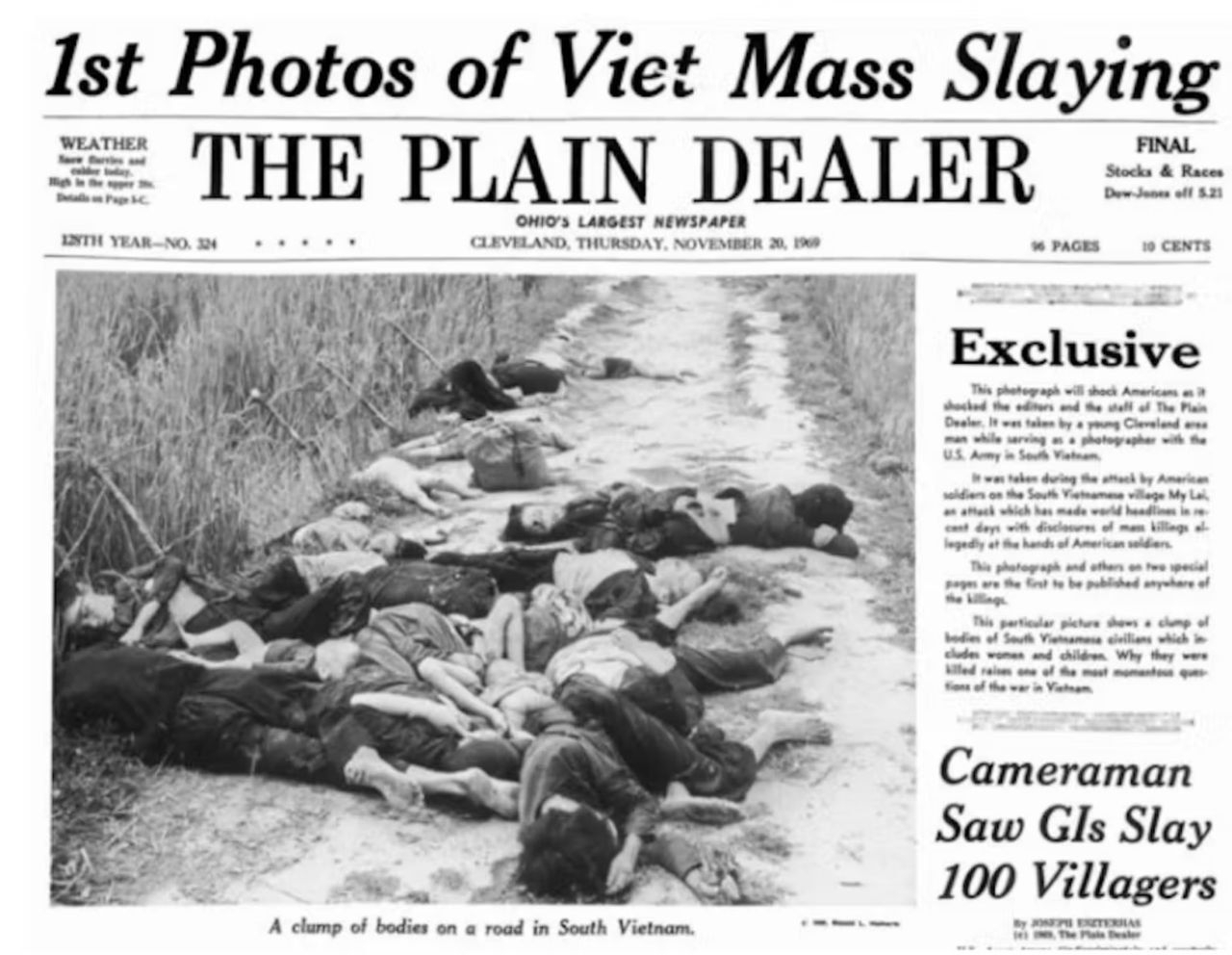
  My Lai Massacre : A tale of rapes and cold blooded killings by US Army. My Lai is a small village in Quang Nai Vietnam. US soldiers used to address this region as "Pinkville"  because of the reddish colour(meaning pro communist region) used to indicate the densely populated My Lai area on military maps.  By the time Charlie Company of the 1st Battalion, 20th Infantry Regiment, 11th Infantry Brigade, arrived in Vietnam in December 1967. “Pinkville” had earned a reputation as a heavily mined hotbed of Viet Cong activity. In January 1968 Charlie was one of three companies tasked with the destruction of the 48th Battalion, an especially effective Viet Cong unit operating in Quang Ngai province. Throughout February and early March, Charlie Company suffered dozens of casualties due to mines and booby traps, but it failed to engage the 48th Batallion. After the debacle of the broad Tet offensive, the...

Right to Recall Done Right: Why Most Existing Versions Fail — and How a Positive, Appearance-Based System Can Deliver Real Accountability

Image
Representative democracy asks voters to make one enormous judgment every five years, and then to live with the consequences of that judgment regardless of what the winner does afterward. If a legislator turns out to be corrupt, negligent, or simply absent, the constitutional remedy is patience — wait for the next election and hope memory holds. Recall mechanisms exist to shorten that feedback loop, and where they have been carefully designed — as more than a century of American, British, Swiss, and German experience shows — they have done exactly that, without the chaos critics predict. But shortening the feedback loop is not, by itself, a design. The record from India's own panchayats and from South America's most recall-heavy democracies shows that a badly built recall tool can produce something worse than the problem it was meant to fix: chronic instability, elite capture, or simple irrelevance. The question worth asking, then, is not whether citizens deserve a shorter leash...

When Bhagat Singh was invited by Joseph Stalin

Image
  When Bhagat Singh was invited by Joseph Stalin A lesser-known event from the annals of the Indian revolutionary movement is the “invitation” that was sent to Bhagat Singh by the Soviet leader, Joseph Stalin. This invite could not reach Singh, so we can only speculate about what might have happened if it had been received and accepted. There is no doubt that had it all gone as planned, it had the potential to change the course of our freedom struggle. It was Shaukat Usmani  who connected Bhagat Singh and Stalin. He was  one of the founding members of the Communist Party of India established in Tashkent in 1920. Usmani was sent to India by MN Roy to establish contact with the Indian nationalists. He came in contact with the revolutionaries through Ganesh Shankar Vidyarthi, the famous editor of the Hindi daily, Pratap, which was published from Kanpur in 1920s. Bhagat Singh worked as a sub-editor at Pratap. He even reviewed Usmani’s political-cum-travel memoir, Peshawar to ...